A phone number QR Code encodes a tel: string rather than a web address, which means the scan opens the dialler with your number already in it and the customer presses call. Nothing loads, no page renders, and no internet connection is required at the moment of scanning.
That technical detail decides almost everything about which generator suits the job. A code carrying a phone number is static by nature, because the number sits inside the pattern itself, so the features that dominate most QR Code comparisons matter far less here than the quality of the file you can print.
Five tools below produce phone QR Codes properly, and prices for four were checked on 25 July 2026, and one well-known option had to be excluded for a reason worth knowing.
What a phone QR Code actually encodes
The pattern holds a short instruction, tel: followed by your number, and the scanning phone recognises it and hands it to the dialler. It is the same mechanism behind a WiFi code or a contact card, and it is why those codes work in a basement with no signal.
There is a practical consequence most people discover late. Because the number is inside the pattern, changing the number changes the pattern, which means a new code and new artwork. A phone QR Code on a van, a shopfront or ten thousand business cards locks you into that specific number permanently.
This is also why one popular tool is missing from the list below. Adobe Express states on its own page that it generates QR Codes for web addresses only, so a phone or contact-card code needs a different tool entirely. It is a capable design product and it cannot do this particular job.
Why most phone codes should be static
Because a tel: code does something a redirect cannot, which is work without a network.
A dynamic QR Code routes the scan through a server, so the phone fetches a URL before anything else happens. That is fine on a poster in a shopping centre and unhelpful on a trade van parked in a rural lane, in a lift lobby, or anywhere with patchy coverage. A static phone code opens the dialler regardless of any of that.
The trade is permanence, and it is worth understanding rather than avoiding. A static code cannot be repointed, so a changed number means reprinting. A dynamic code can be repointed, and the cost is that it lands on a page carrying a call button rather than dialling straight away, and that page needs a connection to load.
Most businesses should take the static route and accept the reprint risk, since a main line rarely changes. The exception is anybody using call-tracking numbers, running campaign-specific lines, or expecting a move, and for them the dynamic option earns its extra step.
The 5 best phone number QR Code generators
Ranked on the quality of the printable file first, then on branding, then on what happens if the number changes.
1. QR Code Monkey
QR Code Monkey is the strongest choice for a phone code and the reason is unglamorous. It produces the best free print file of anything here, and a phone code is almost always a print job.
Downloads come as PNG, SVG, PDF and EPS, all free, which is the complete set a sign writer or a business card printer will ask for. Vector output matters more on a phone code than on most others, because these end up on vehicle livery, shop windows and A-boards, all of which are printed large and none of which forgive a raster file that has been scaled up.
There is no account, no signup and no watermark, and the codes never expire and carry no scan limit. Customization runs deeper than any competitor here, with gradient foregrounds, a separate eye colour, and independent control of body, eye frame and eye ball shapes, plus a logo slot with an option to remove the background behind the image.
The limitations barely apply to this use case, which is why it wins. Codes are static, and a phone code should be static anyway. There is no dashboard and no scan data, and a code encoding tel: cannot be tracked by anybody regardless of tool. One documented quirk does matter: their own notes state the logo and design settings carry into the PNG and SVG exports but not into PDF or EPS, so open the file before sending it to a printer.
2. The QR Code Generator (TQRCG)
The QR Code Generator's phone QR Codes come with something QR Code Monkey structurally cannot offer, which is a route out of the reprint problem, and with free branding that makes the code look deliberate rather than pasted in.
Take the branding first, because unlimited free static QR Codes cover the phone code itself, and customization sits on the free plan, so brand colours, an embedded logo and a call-to-action frame all cost nothing. A frame reading Scan to call us converts far better than a bare square on a shopfront, and several tools in this comparison have no frame option at all.
Now the reprint question, which is where this becomes the better choice for a lot of businesses. If your number might change, because you are moving, porting a line, or running call tracking, the 2 free dynamic QR Codes that never expire give you an alternative. Point one at a contact page carrying a tap-to-call button, and you can change the number behind it without touching the van, the sign or the cards.
That version needs a connection to load, which the static tel: code does not, so it is a genuine trade rather than a free upgrade. For a shopfront on a high street it is the right call, and for a trade van working rural jobs the static code wins.
Two honest limits apply here. Free static downloads carry a watermark, which looks wrong on a business card, and clearing it means Flex at $5 per month billed yearly for 5 dynamic QR Codes, rising to $10 per month billed yearly for 45. Both tiers are also single-user. For a business printing anything customer-facing, the $60 a year buys clean output plus the editable fallback, and TQRCG's branded call codes are the most complete answer on this page once that is paid.
3. QR Code Prime
QR Code Prime's phone QR Code generator produces a clean, unwatermarked file with no account at all, and for a one-off phone code that is the fastest correct answer available.
It carries a dedicated phone code type alongside eleven others, so you are not improvising with a text field. Colour control, dot styles, logo embedding and eight brand presets are included, and downloads come as PNG and SVG, which covers screen use and most print work.
The property that stands out for a phone code specifically is where the generation happens. Static codes are built inside your browser, so the number you encode never reaches their servers. Most people will not care, and anybody encoding a personal mobile or a direct line rather than a switchboard might.
Two gaps affect print work specifically. There is no PDF or EPS export, so a sign writer insisting on either will need a conversion, and there is no call-to-action frame, so any Scan to call wording has to sit in your artwork. One independent developer maintains it, with no published compliance certifications, which matters less on a static phone code than almost anywhere else, since nothing is being stored or tracked.
4. QR TIGER
QR TIGER is the choice when the phone code is one item in a larger set rather than a standalone asset. Its free generator carries logo upload, brand colours, patterns, eye styles and custom call-to-action frames with editable text, which is an unusually complete set of free design controls.
The frame is the differentiator worth paying attention to. Being able to set your own wording, rather than picking from a fixed list, means a code can read Call the workshop or Ring for a quote rather than a generic instruction, and on trade signage that specificity earns its place.
The free tier also includes unlimited static codes, so the phone code itself costs nothing, alongside 3 dynamic codes with 500 scans each. Advanced costs US$16 per month billed annually for 200 dynamic codes and batch creation of up to 3,000 per upload, which suits a franchise or a multi-branch operation generating a code per location.
The condition on the free tier is the problem for customer-facing print. Free codes carry a QR TIGER logo popup, which puts another company's branding onto your shopfront. Their terms also state that dynamic codes stop working when a plan expires, though that affects the dynamic option rather than a static phone code.
5. Hovercode
Hovercode sits fifth for a phone code and it is worth knowing about for the business that wants everything in one dashboard rather than the best individual file.
The free plan costs $0 a month and covers unlimited static codes, 3 dynamic codes held in total, unlimited scans, logo branding and three months of analytics history, with no advertising on scan. Their written commitment that the first three dynamic codes stay live even after a cancellation is the strongest durability statement in this comparison.
For a phone code specifically that durability is less relevant, since a static tel: code depends on nobody. It becomes relevant if you take the contact-page route described above, because that page-based code is the one that can be switched off by a billing problem, and Hovercode is the cheapest tool here that promises it will not be.
Pro costs $12 per month billed monthly or $120 a year for 100 dynamic codes held in total, and Business costs $39 per month or $390 a year. The gap for print work is that neither the pricing nor the features page publishes which file formats you get, so a vector requirement needs confirming before you commit.
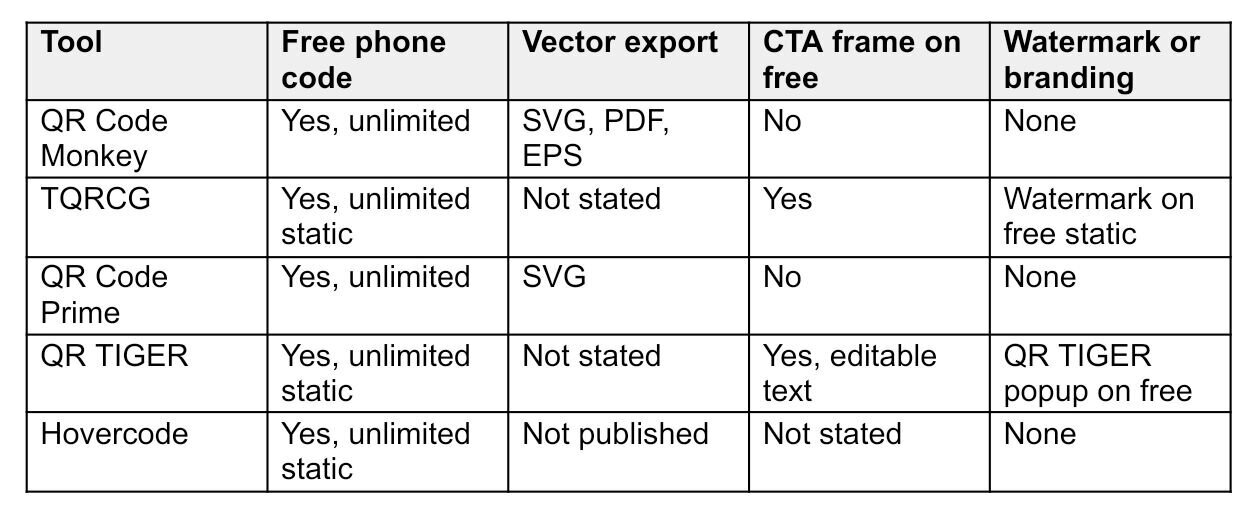
Output and branding, side by side
Which one suits where the code is going?
Three questions, and the first one settles most cases on its own.
Is it going on print, or on a screen?
Print needs vector, and that puts QR Code Monkey first for vehicle livery, shopfronts, A-boards and business cards, since SVG, PDF and EPS all come free. QR Code Prime provides SVG, which covers most jobs a local printer will handle.
Screen use reverses the priority entirely, because a phone code in an email signature or on a website only needs a decent PNG, so file format stops mattering and branding becomes the deciding factor, which is where TQRCG's free frames and colours pull ahead.
Could the number ever change?
Answer this honestly rather than optimistically, because the cost of getting it wrong is a reprint rather than a subscription. A main switchboard that has been the same for a decade is safe as a static code. A campaign line, a call-tracking number, or a business planning a move is not.
If the number might change, use a dynamic code pointing at a contact page with a call button. TQRCG gives you 2 of those free and Hovercode gives you 3, and both state that those codes survive a cancellation, which matters when the alternative is reprinting a van.
Who might tamper with it?
A phone code is an unusually attractive target for substitution, because a swapped code dials a number the scanner trusts. Barracuda Networks reported that QR Code and voicemail phishing together accounted for around 20% of overall phishing detections in 2024, a figure covering both categories rather than QR Codes alone.
The defence here is physical rather than technical. Print the code into the sign or the card rather than applying a sticker, since a printed code cannot be lifted without visible damage, and check anything on a public-facing window periodically. This is one of the better arguments for branding the code, because a customer who knows what your code looks like is more likely to notice one that has been replaced.
Dial it yourself before the print run
Generate the code, export it at final size, print one copy on the actual stock, and scan it with a phone that is not the one you made it on. Then check what appears in the dialler, digit by digit.
International formats are where this most often goes wrong. A number entered without a country code works locally and fails for anyone dialling from abroad, and a number entered with spaces or brackets sometimes survives the encoding and sometimes does not. Two minutes of checking prevents a batch of cards that dial nothing.
Print remains the natural home for these codes, and the survey data agrees, since Bitly's 2025 survey of 250 marketers found print advertising among the most common QR Code placements at 40%, and EMARKETER's February 2024 forecast put 38.0% of people in the US as scanning a QR Code at least once a year, so the audience for a code on a shopfront is already there.
Phone QR Code questions worth answering first
Does a phone QR Code dial automatically when scanned?
No, and that restriction is deliberate. The scan opens the dialler with your number filled in, and the person presses call themselves. No operating system will place a call without that confirmation, which is a sensible protection against a malicious code dialling a premium-rate line from somebody's pocket.
Can you track scans on a phone number QR Code?
Not on a static one, because a tel: code sends the instruction straight to the dialler with no server in between and nothing to count. If scan data matters, the alternative is a dynamic code pointing at a contact page with a call button, which routes through a server and can therefore be counted. You are then measuring page visits rather than calls.
Do phone QR Codes work without internet?
Yes, and this is their main advantage over a link-based alternative. The number is encoded in the pattern, so the phone reads it locally and opens the dialler with no connection required. A dynamic code pointing at a contact page does need a connection, which is worth remembering for codes going into lift lobbies, basements or rural locations.
What happens if we change our phone number?
A static phone code becomes useless and the artwork has to be reprinted, since the number lives inside the pattern. There is no way to edit a static one after printing. If a change is plausible, use a dynamic code pointing at a page you control, so the number behind it can be updated without touching anything printed.
Should the code include the country code?
Yes, for anything a visitor or an overseas customer might scan. A number stored in full international format works from everywhere, whereas a local format fails for anyone dialling from abroad and sometimes for mobile users on a different network. Test the exported code from a phone with a different country setting if the audience is likely to be international.
Media Contact
Mike Thomas
QR Code Generators
https://www.the-qrcode-generator.com/