Superior Grouting Services, Inc. provides compaction grouting, cellular grouting, and pipeline abandonment grouting for oilfield and midstream infrastructure across the Permian Basin, with field operations centered on Midland and Odessa, Texas. The contractor stabilizes drilling pads, frac pump pads, compressor station foundations, and sand transload yards built on the region's caliche-over-silt soils, and closes retired gathering and saltwater disposal lines with placement documented for Railroad Commission of Texas District 8 records.
The engineering driver is consistent across the basin. A cemented caliche cap carries load well until a heavy point load from a drilling rig, frac pump, or tank battery punches through it, after which bearing capacity drops to the softer silt and sand below. Superior Grouting reports that the failure mode is rarely the caliche itself but the loose strata beneath the cap losing strength under sustained loading. Compaction grouting densifies that lower column, while polyurethane injection resets slabs that have already settled, without pulling equipment offline.

In Midland and the adjacent Martin and Andrews county oilfields, Superior Grouting Services rebuilds drilling pads, recovers settled equipment foundations through controlled lifting, and batches cellular concrete on site for void fills behind tank rings and along pipeline corridors.
Caliche, Frac Pads, and Pipeline Closures: The Numbers Behind the Permian Work
- More than 1,424,346 linear feet grouted and 1,992,265 square feet of concrete raised across four decades, including Permian Basin drilling pads, service yards, and pipeline corridors.
- Cellular concrete batched on site at 20 to 70 PCF and pumped thousands of feet at low pressure into abandoned pipe and annular space that ready-mix trucks cannot reach across basin distances.
- Polyurethane lifting foam cures at roughly 4 PCF, far lighter than the 100-plus PCF cement slurry used in mudjacking, so it does not re-load the silt layers beneath the caliche cap.
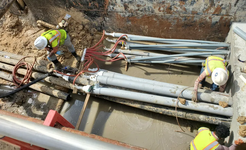
- Pipeline abandonment grouting bulkheaded at both ends, vented at the high points, and pumped until return pressure confirms a continuous column, documented for Railroad Commission of Texas District 8 records.
- Foam slab lifting runs roughly 50 to 70 percent below the cost of full slab tear-out and replacement and returns a floor to traffic within a single shift.
- Zero-incident safety record across TRIR, DART, and fatality metrics, with ISNetworld certification required for Permian Basin facility access.
- Crews mobilize from Houston, approximately 475 miles to Midland and 490 miles to Odessa via Interstate 20.
Across Odessa and the Ector County service-yard belt, Superior Grouting Services densifies subgrade beneath frac pump pads, sand transload skids, and rig-up yards that carry some of the heaviest concentrated loads in Texas. According to Superior Grouting, operators across the basin schedule grouting around production windows, and the company's methods are built for that constraint. Polyurethane cures in minutes, so a frac pump pad, transload apron, or warehouse bay returns to service inside a routine maintenance window rather than absorbing the multi-day cure that cement-based repair requires.
Frequently Asked Questions
Q: How much does concrete leveling cost versus replacing a slab at a Permian Basin facility?
According to Superior Grouting, polyurethane foam lifting runs roughly 50 to 70 percent below the cost of full slab tear-out and replacement on Midland and Odessa flatwork. The company reports that a treated floor returns to traffic within a single shift, while a tear-out requires demolition, haul-off, rebar, forming, and weeks of cure. For active service yards, the firm notes that downtime, not material cost, usually drives the decision.
Q: Why do drilling pads and equipment foundations settle on caliche soil in the Permian Basin?
Per Superior Grouting, a cemented caliche cap carries load well until a heavy point load from a drilling rig, frac pump, or tank battery punches through it, after which bearing capacity drops to the softer silt and sand below. The company reports that the loose lower strata, not the caliche itself, are usually the control on long-term settlement. Compaction grouting densifies that lower column so the load transfers into strengthened soil rather than the weak zone beneath the cap.
Q: What is the difference between compaction grouting and polyurethane injection for oilfield pads?
According to Superior Grouting, compaction grouting injects low-mobility grout through small-diameter casings to densify the soil column and restore bearing capacity beneath a pad, while polyurethane injection lifts concrete that has already settled. The company reports that cured polyurethane weighs about 4 PCF, so it resets slabs without re-loading the silt beneath the caliche cap. The firm notes that many Permian projects use both, densifying the subgrade and lifting the flatwork above it.
About Superior Grouting
Superior Grouting Services, Inc. is a specialty pressure grouting contractor founded in 1983 by Ron Rumpza and headquartered at 8927 Meadow Vista Blvd in Houston, Texas. The company provides compaction grouting, cellular grouting, polyurethane concrete raising through its SUPERIOR Polylift method, annular grouting, abandonment grouting, and concrete leveling for commercial, industrial, and municipal clients. Superior Grouting serves an eleven-city service area across Texas and Louisiana, including Houston, Midland, Odessa, Austin, Dallas, and San Antonio.
###
Contact
Superior Grouting Services, Inc.
8927 Meadow Vista Blvd, Houston, TX 77064
Phone: 281-937-8141
https://www.superiorgrouting.com
Facebook: https://www.facebook.com/SuperiorGroutingServicesInc
YouTube: https://www.youtube.com/@superiorgroutingservices
TikTok: https://www.tiktok.com/@superiorgroutingservices
LinkedIn: https://www.linkedin.com/company/superiorgrouting