Tile Roofing San Diego has published a new educational resource to help homeowners, HOA boards, and property managers understand why tile roofs can develop leaks without showing obvious cracked or broken tiles.
The guide, Tile Roof Leak Without Broken Tiles, explains how hidden roofing components such as underlayment, flashing, valleys, and penetration details can deteriorate and allow moisture to reach the roof deck.

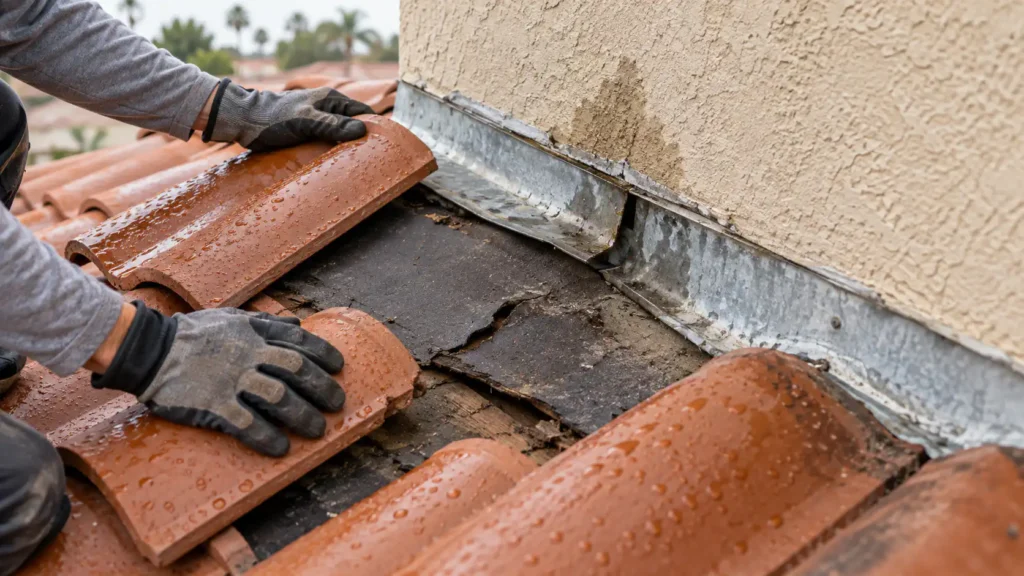
Clay and concrete tiles form the visible exterior layer of a tile roofing system, but they are not the only protection against water intrusion. Underlayment acts as a secondary drainage barrier, while flashing redirects water around walls, chimneys, skylights, vents, and other roof transitions.
Over time, underlayment can become brittle, tear around fasteners, or deteriorate beneath otherwise intact tiles. This can create leaks that remain difficult to identify from a ground-level inspection.
As a specialized tile roofing company, Tile Roofing San Diego focuses exclusively on tile roofing systems and the hidden components that support their long-term performance.
Flashing, Valleys, and Penetrations Can Create Hidden Leak Paths
Roof leaks do not always originate directly above an interior water stain. Moisture can enter around flashing, valleys, roof-to-wall connections, plumbing vents, skylights, or other penetrations and then travel along decking or framing before becoming visible indoors.
Roof valleys are especially important because they collect runoff from multiple roof planes. Debris, damaged underlayment, corrosion, poor overlaps, or older repairs can interfere with proper drainage.
Property owners searching for tile roof in San Diego should therefore consider the entire roof assembly rather than focusing only on visible tile damage.
The same principle applies to concrete roofing systems. Owners evaluating cement tiles roof in San Diego properties should also assess the condition of underlayment, flashing, valleys, and drainage details beneath the tile surface.
Accurate Inspection Helps Determine the Right Repair
A tile roof leak inspection may include evaluation of flashing, valleys, roof penetrations, previous repairs, roof-to-wall transitions, debris accumulation, and accessible underlayment.
In some cases, selected tiles may need to be carefully lifted to inspect the materials beneath them.
For HOAs and multi-unit properties, documentation is especially important. Several interior leaks may originate from the same roof area, valley, or aging section of underlayment rather than from multiple unrelated failures.
A leaking tile roof does not always require full replacement. Depending on the condition of the system, the appropriate solution may involve localized repair, flashing correction, underlayment replacement, or a lift-and-relay process that preserves reusable tiles while addressing damaged materials beneath them.
By publishing this resource, Tile Roofing San Diego is helping San Diego property owners better understand hidden tile roof leak causes and make more informed decisions about inspection, maintenance, and repair.
About Tile Roofing San Diego
Tile Roofing San Diego specializes exclusively in tile roofing systems throughout San Diego, California. The company works with clay and concrete tile roofs and provides tile roof inspections, leak diagnosis, repairs, maintenance, and lift-and-relay solutions.
###
Contact
Tile Roofing San Diego
3919 30th St, Ste 205, San Diego, CA 92104
619-350-1086
[email protected]
https://tileroofsandiego.com/
YouTube: https://www.youtube.com/@TileRoofingSanDiego